Scribblenauts For Software
I once had a girlfriend who loved the game Scribblenauts, and I loved watching her play it on her Nintendo DS. The premise seems simple: the main character Maxwell navigates through levels by solving puzzles. But there’s a twist.
Need to fly? Type “jetpack” and a jetpack appears. Need to write something? Ask for a pencil. The game has an extensive vocabulary and rewards creativity, so rather than typing “fire”, you might as well type “dragon” or “Cthulhu” to summon a fully formed monster with all its physical properties at your disposal.
I’ve mentioned the concept of on-demand software a handful of times, and expanded on it in my recent talk at NSSpain. For that talk, I wanted slides that looked identical to ChatGPT’s interface but with my talk’s color scheme.
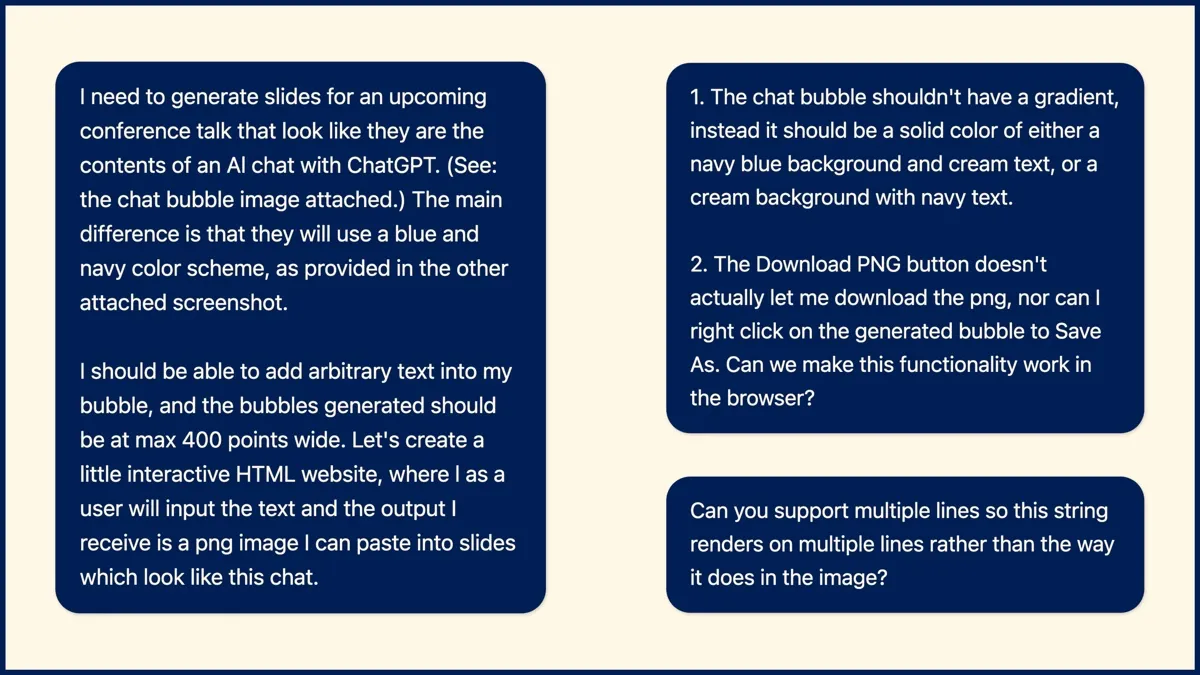
I built exactly that in a Claude Artifact, and it took less than five minutes using these prompts. I didn’t write any code — I just described my problem and told Claude what I needed. That’s what I mean when I say Scribblenauts for Software.
Building Your First On-Demand Software
Is this chat bubble generator my life’s work? Of course not. It’s just a simple tool — but humans are tool builders. For a motivated developer, building the tools you need on-demand with the help of AI is empowering. Rather than sitting in Keynote all day manipulating shapes until they look just right, I automated the process by creating a piece of software.
Three prompts and five minutes later, I had exactly what I needed. No code, no thinking required — just a usable and reusable piece of software. Don’t like how it came out? Ask for something different. Don’t like it at all? Start over with a completely different direction, this time telling the AI exactly what you don’t want.

This XKCD comic about automation used to be funny because it was true. Spending hours to automate a five-minute task was absurd, but the timetable has changed. Now you can spend five minutes building something that would have previously taken a day, or an hour building something that would have taken a week.
Not every problem is this simple to describe, but sometimes it really is this easy. Today the cost of making throwaway software that helps you accomplish a specific task is practically zero.
Building More Complex On-Demand Software
I’ve spent the last few years bouncing between curl and tools like Paw or Postman to test Plinky’s API. I use curl when I need something quick and dirty, and a GUI tool when I want to save and reuse an endpoint.

But what if I had a personalized tool made just for Plinky? What if I could simply type Create tag build.ms and have AI create and execute the correct curl request for me? This is Scribblenauts for Software thinking.
- I open up OpenAI’s Codex and ask it to read through my code for Plinky’s API layer to understand all of the endpoints I have.
- I ask Codex to generate an OpenAPI spec from my code, so now I have a formal document that describes all my endpoints and parameters.
- Codex builds a Python script called
plinky-api, using GPT-5 to analyze my command line input and read through the OpenAPI spec to determine which route I’m most likely trying to call.
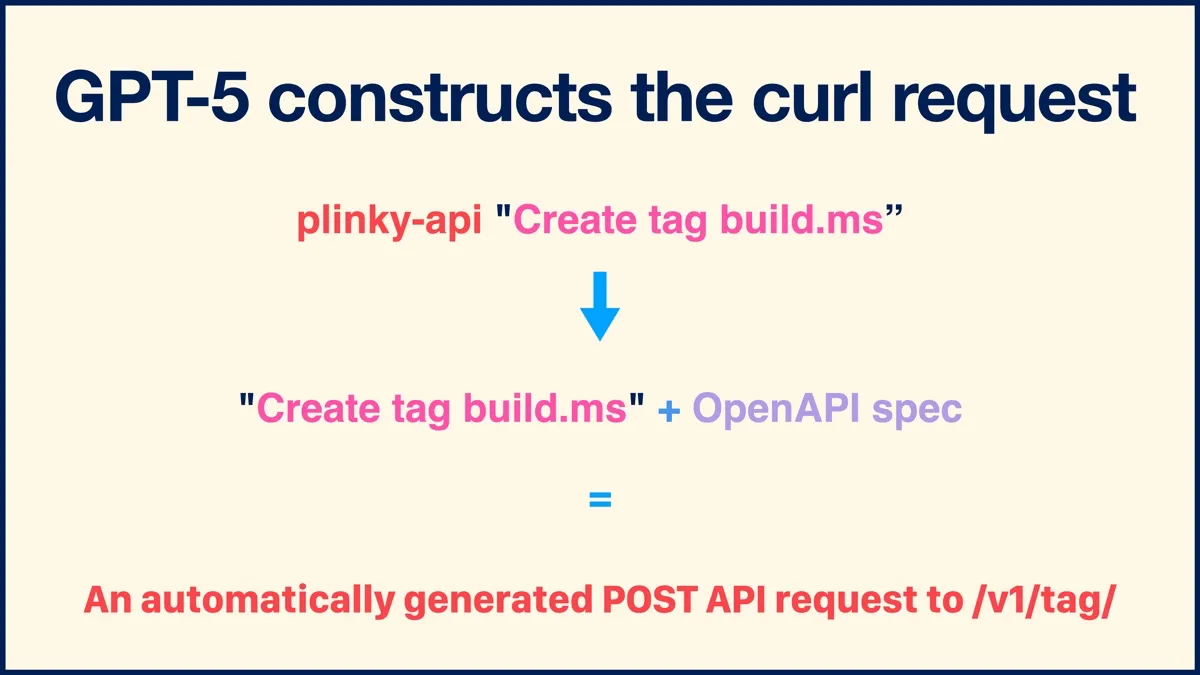
Now when I run plinky-api "create tag build.ms", Codex:
- Chooses the right endpoint
- Constructs a curl request to add a new tag named build.ms
- Executes the curl request for me
I now have a personalized tool that tests my API. No fiddling with curl requests, finicky GUI tools, or keeping all of Plinky’s API routes in my head. I came up with and built this in 15 minutes, and most of that time I was off doing something else while Codex wrote the code. It took a couple of iterations to perfect, but that’s nothing compared to the time I’ve saved since — let alone making my life a little less annoying.
Scribblenauts for Software
We truly are at the beginning of an era of personalized on-demand software. Today, you can solve practically any problem by creating your own bespoke software. If you have a ChatGPT subscription, Codex is included for free, and Claude Code is included in Claude subscriptions. This means that right now, you can build any tool you want. This is Scribblenauts for Software, and it’s a big deal.
Today I’m using AI to build my own tools. Tomorrow developers will use AI to build games with interactions that feel dynamic and realtime.1 Give it a decade and many entertainment experiences will be intermediated with AI to feel alive, even when they’re artificial in nature. When you can infuse everything with AI, suddenly everything becomes a canvas drawn from unlimited objects — much like Scribblenauts.
P.S. Want to learn how to build tools like this? I teach hands-on workshops that guide you through every step of the way.